Zoetis Dectomax Injectable 500mL - 10mg/mL Doramectin
Delivered prices are estimates — your exact freight is worked out on your postcode and confirmed at checkout before you pay. In-store is free pickup from our Gympie yard.
- Active ingredient
- Doramectin 10 mg/mL
- Controls
- Cattle: Adult and immature gastrointestinal roundworms: Ostertagia ostertagi (including inhibited larvae) - small brown stomach worm; Haemonchus placei - Barber's pole...
- Suitable for
- Cattle, Pigs
- Withholding period
- Cattle meat: DO NOT USE less than 42 days before slaughter for human consumption. Cattle milk: DO NOT USE during lactation or less than 60 days before calving when milk or milk products are to be used for human consumption or processing. Pigs: DO NOT USE less than 35 days before slaughter for human consumption. ESI: DO NOT USE less than 42 days before slaughter for export (APVMA 46128). — always confirm on the registered label
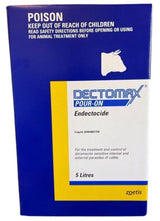
Dectomax Injectable Endectocide. Doramectin 10 mg/mL. Signal heading: CAUTION (Schedule 5). For animal treatment only.
The label says: "For the treatment and control of doramectin sensitive internal and external parasites of cattle and pigs."
Cattle: Dectomax Injectable Endectocide is for the treatment and control of doramectin sensitive internal and external parasites of cattle, providing persistent protection against reinfection by Small Brown Stomach worm, Stomach Hair worm, Small Intestinal worm, Barber's Pole worm, Hookworm, Nodule worm, Lungworm and Cattle Tick.
Pigs: Dectomax Injectable Endectocide is for the treatment and control of doramectin sensitive internal and external parasites of pigs, providing persistent protection against reinfection by Ascaris suum and mange mite.
Cattle parasites (label list): Adult and immature gastrointestinal roundworms: Ostertagia ostertagi (including inhibited larvae) - small brown stomach worm; Haemonchus placei - Barber's pole worm; Trichostrongylus axei - stomach hair worm; T. colubriformis - black scour worm; T. longispicularis (adults only); Cooperia oncophora - small intestinal worm; Cooperia spp; Bunostomum phlebotomum (adults only) - hook worm; Oesophagostomum radiatum - nodule worm; Toxocara vitulorum (adults only) - round worm. Adult and immature lungworm: Dictyocaulus viviparus. Sucking lice: Linognathus vituli, Solenopotes capillatus, Haematopinus eurysternus. Biting lice: effective as an aid in the control of biting louse (Bovicola bovis). Cattle tick (Boophilus microplus): for the treatment and control of doramectin sensitive cattle tick, including synthetic pyrethroid, organophosphorus and amidine resistant strains; the persistence of doramectin prevents the development of viable cattle ticks for a period of 28 days. Mange mites: Chorioptes bovis; Sarcoptes scabiei var bovis (not present in Australia).
Cattle persistent protection against reinfection: Ostertagia ostertagi up to 21 days; Cooperia oncophora up to 14 days; Cooperia spp up to 21 days; Haemonchus placei up to 21 days; Dictyocaulus viviparus up to 28 days; Oesophagostomum radiatum up to 21 days; Trichostrongylus axei up to 21 days; Bunostomum phlebotomum up to 21 days.
Pig parasites (label list): Adult and immature gastro-intestinal roundworms: Hyostrongylus rubidus - red stomach worm; Ascaris suum - large roundworm; Strongyloides ransomi (adults only) - intestinal threadworm; Oesophagostomum dentatum - nodule worm; Oesophagostomum quadrispinulatum - nodule worm; Trichuris suis (adults only) - whipworm. Adult lungworms: Metastrongylus spp. Adult kidney worms: Stephanurus dentatus. Sucking lice: Haematopinus suis. Mange mites: Sarcoptes scabiei var suis.
Pig persistent protection: Ascaris suum at least 7 days; Sarcoptes scabiei var suis at least 18 days.
Dose: Cattle: 1 mL per 50 kg bodyweight by subcutaneous (S/C) injection. Pigs: 1 mL per 33 kg (0.3 mL per 10 kg) bodyweight by intramuscular (I/M) injection. Inject into the neck region, preferably high up behind the ear.
Restraints: DO NOT USE in cattle during lactation or less than 60 days before calving when milk or milk products are to be used for human consumption or processing. DO NOT USE in animals within 28 days (4 weeks) of a previous treatment.
Withholding periods: Cattle meat: DO NOT USE less than 42 days before slaughter for human consumption. Cattle milk: DO NOT USE during lactation or less than 60 days before calving when milk or milk products are to be used for human consumption or processing. Pigs: DO NOT USE less than 35 days before slaughter for human consumption.
Export Slaughter Interval (ESI): DO NOT USE less than 42 days before slaughter for export. Confirm the current ESI with the manufacturer or the APVMA website before use.
Safety directions: Poisonous if swallowed. Avoid contact with skin. First aid: If poisoning occurs contact a doctor or Poisons Information Centre. Phone Australia 131126.
Use contents within 28 days of first broaching of the vial. Store upright. Discard the unused portion. Store below 30°C (Room temperature). Label pack sizes: 200 mL and 500 mL multidose packs.
Always read the registered label before use (APVMA 46128).
Active Ingredient: Doramectin 10 mg/mL
Chemical Schedule: S5
APVMA Reg. No: 46128
For use on: Cattle, Pigs
Cattle meat: DO NOT USE less than 42 days before slaughter for human consumption. Cattle milk: DO NOT USE during lactation or less than 60 days before calving when milk or milk products are to be used for human consumption or processing. Pigs: DO NOT USE less than 35 days before slaughter for human consumption. ESI: DO NOT USE less than 42 days before slaughter for export (APVMA 46128).
Always read the current registered product label before use. Withholding periods must be observed before slaughter, milking, or egg collection. The label supplied with the product is the legal document and takes precedence. If in doubt, contact TGRM on (07) 5482 1692 or the manufacturer directly.
Always read the current registered product label before use. Dose rates and withholding periods on this page are provided as a guide only. The registered label supplied with the product is the legal document and takes precedence. If in doubt, contact TGRM on (07) 5482 1692 or the manufacturer directly.
Always read the label and follow directions for use. The registered label is the legal document governing use of this product.
Download the Safety Data Sheet for this product:
Download SDS (PDF)Required for safe handling and storage. Keep on-site per WHS regulations.
Common Questions
What does Dectomax Injectable control?
The label says it is for the treatment and control of doramectin sensitive internal and external parasites of cattle and pigs. In cattle this includes gastrointestinal roundworms, lungworm, sucking lice, cattle tick (including synthetic pyrethroid, organophosphorus and amidine resistant strains), and mange mites, and it aids in the control of biting lice. In pigs it includes roundworms, lungworms, kidney worms, sucking lice and mange mites.
What is the dose for cattle and pigs?
Cattle: 1 mL per 50 kg bodyweight by subcutaneous injection. Pigs: 1 mL per 33 kg (0.3 mL per 10 kg) bodyweight by intramuscular injection. Inject into the neck region, preferably high up behind the ear. For cattle, the dose rate is to be based on the heaviest cattle in each group; do not underdose.
What are the withholding periods?
Cattle meat: DO NOT USE less than 42 days before slaughter for human consumption. Milk: DO NOT USE during lactation or less than 60 days before calving when milk or milk products are to be used for human consumption or processing. Pigs: DO NOT USE less than 35 days before slaughter for human consumption. Export Slaughter Interval: 42 days; confirm the current ESI with the manufacturer before use.
How long does the persistent protection last?
Cattle: Ostertagia ostertagi, Cooperia spp, Haemonchus placei, Oesophagostomum radiatum, Trichostrongylus axei and Bunostomum phlebotomum up to 21 days; Cooperia oncophora up to 14 days; lungworm (Dictyocaulus viviparus) up to 28 days; viable cattle ticks prevented for 28 days. Pigs: Ascaris suum at least 7 days; Sarcoptes scabiei var suis at least 18 days.
How often can I treat?
DO NOT USE in animals within 28 days (4 weeks) of a previous treatment. Once broached, use the contents within 28 days and discard the unused portion.
Where can I get more help?
Additional information is in the Material Safety Data Sheet. You can also contact TGRM on (07) 5482 1692 or visit us at 55 Tozer St, Gympie.
Do you ship this product Australia-wide?
As a regulated chemical, this product can only be transported by road freight, it cannot be sent via Australia Post or air freight. Call us on (07) 5482 1692 before ordering to confirm delivery to your area.
Mainland Australia only — we’re unable to deliver this product to Tasmania. It is classified as environmentally hazardous (a marine pollutant), so it is regulated as a dangerous good for sea and air transport and our freight carriers will not accept it on those routes. Because every route to Tasmania and offshore destinations needs a sea or air leg, we can only deliver it to mainland addresses by road. Call us on (07) 5482 1692 if you are unsure about your address.
Can you deliver this to Tasmania?
Not at this time. This product is environmentally hazardous (a marine pollutant), so it is regulated as a dangerous good for sea and air freight and our carriers do not accept it on those routes. As every route to Tasmania involves a sea or air crossing, we can only deliver it within mainland Australia by road. If you are in Tasmania, please call us on (07) 5482 1692 and we will help you find an alternative product.
Can I Click & Collect from Gympie?
Yes — Click & Collect is available from our store at 55 Tozer St, Gympie. Open Mon–Fri 8am–5pm and Sat 8am–12pm. Click & Collect is FREE on orders of $175 or more, or a flat $10 on orders under $175. Select Click & Collect at checkout and we will have your order ready.